

We provide specialized winterization services to safeguard your pool during the off-season, and when spring arrives, we handle the thorough opening process.


Sign Up to get updates & news about us . Get Latest Deals from Walker's Inbox to our mail address.
Sign Up to get updates & news about us . Get Latest Deals from Walker's Inbox to our mail address.
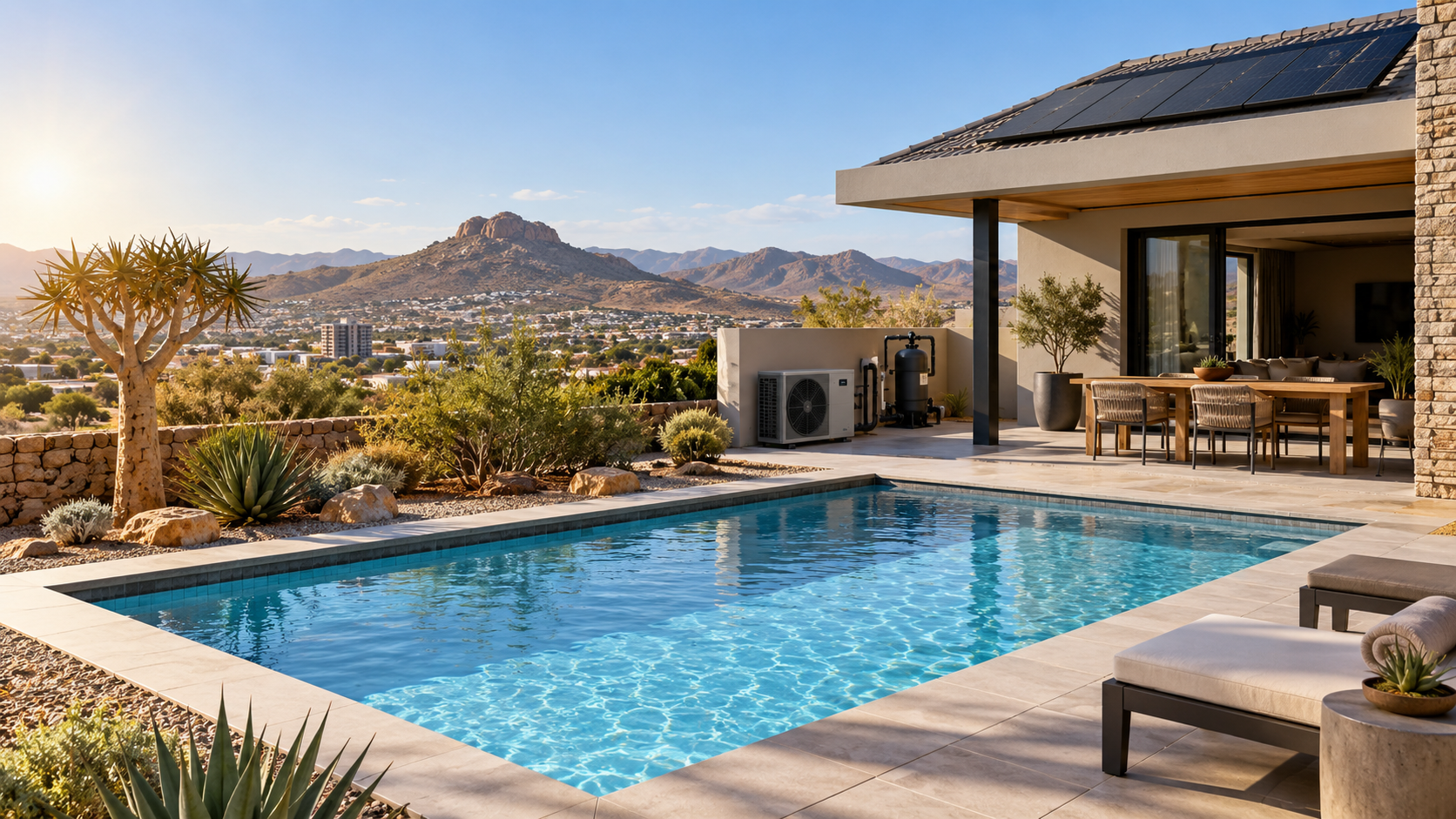
A pool can feel comfortable during Windhoek’s warmer periods and still become too cool to use regularly once evenings, nights and seasonal conditions change. The first decision is therefore not simply whether to install a heater. It is how much longer you want to use the pool beyond the naturally warm part of the year.
Premium Pools Namibia can assist with heat-pump and solar pool-heating options in Windhoek. The right approach depends on the swimming season you want, how exposed the pool is, how much heat is being lost from the water and whether the existing circulation and plumbing can support the heating system.
A household that mainly wants to take the chill off the water during the shoulder seasons has a different requirement from a property that wants the pool to remain comfortable through much cooler periods.
That difference affects the amount of heating support the pool may need. Pool size matters, but so do the months in which the pool will be used, the preferred water temperature, how often people swim and how quickly the pool loses heat between uses.
Windhoek can have warm, sunny days while nights and early mornings become considerably cooler, especially in winter. A pool can therefore gain warmth during the day and lose a noticeable amount again when the surrounding air cools.
It is useful to define the target before choosing equipment. If the aim is occasional extra comfort, the heating approach may be different from a pool expected to support frequent use over a longer season.
Time of day also matters: a pool mainly used on sunny afternoons may need less active support than one the household wants comfortable in the morning or evening after overnight cooling.
The system should be chosen around the owner’s actual swimming pattern rather than the assumption that every heated pool needs the same temperature throughout the year.
Adding heat is only one side of the problem. If the pool is losing that heat quickly from the water surface, a larger heating system may spend more time replacing warmth that could have been retained.
Evaporation is especially relevant in Windhoek’s dry environment. When water evaporates from the surface, heat leaves with it. Wind and cooler air can increase the rate at which an uncovered pool loses warmth, particularly when the pool is not being used.
A suitable pool cover can help reduce evaporation and surface heat loss. This does not mean the cover replaces active heating. Its role is to help the pool hold onto more of the warmth already gained from sunny conditions, a heat pump or a solar-heating system.
For an owner considering heating, it therefore makes sense to think about heat retention before simply increasing heating capacity.
If the pool is regularly left uncovered between uses, even suitable heating equipment may need to replace more lost warmth before the water reaches the owner’s preferred comfort level again. Pool covers in Windhoek remain a separate cover-selection service because safety, fit, evaporation control and everyday handling involve their own decisions.
Complete the form below and Premium Pools Namibia will get back to you about pool heating for your Windhoek property.
Both systems can add useful heat, but they do so differently.
A pool heat pump uses electricity to move heat from the surrounding air into the pool water. It offers more direct control over when active heating is used, but its output changes with ambient conditions. Cooler air gives the system less available heat to work with than warmer daytime conditions.
Solar pool heating uses collectors exposed to sunlight and circulates pool water through the heating system so solar energy can be transferred to the water. Windhoek’s strong solar resource can make this a credible option where the property has suitable, sufficiently exposed collector space.
The better choice depends on the property and the result the owner wants. A heat pump may suit someone who values more controllable heating over a defined swimming season. Solar can suit a property with useful sun exposure and suitable collector space where the owner is comfortable with heating output that follows solar conditions more closely.
The two approaches are not automatically interchangeable. Available electrical supply, plumbing routes, equipment space, roof or collector area, shading and the existing circulation system can all affect what is practical at the property.
Windhoek’s climate creates a useful but demanding combination for pool heating. Sunny daytime conditions can support natural warming and solar collection, while cooler nights can increase the amount of heat the pool loses before the next swimming period.
That means the same heating system will not deliver one identical result every day of the year. A heat pump working during warmer ambient conditions can have a different output from the same unit operating in colder air. Solar heating likewise depends on the amount of useful sunshine reaching the collectors.
Pool exposure matters too. A sheltered pool can behave differently from one exposed to wind, and two similar-sized pools can lose heat at different rates because of their surroundings and how often they are covered.
This is why heating should be planned around the Windhoek property rather than around a headline capacity alone. The intended swimming season, the times of day the pool is normally used and the way the property handles heat gain and heat loss all influence how much active heating is useful.
Adding heating to an existing pool normally means connecting another component to a circulation system that was originally designed around the pump, filter and plumbing already in place.
For a heat pump, there needs to be a practical plumbing route, suitable equipment space and the electrical requirements for the selected system. For solar heating, the installation needs a viable route to and from the collectors as well as suitable collector space with useful sun exposure.
The existing pump and filter also matter because water has to circulate through the heating system. A heating upgrade should not be expected to correct an existing circulation fault. If flow is already weak, the pump repeatedly loses prime or the filter is not operating properly, pool pumps, filters and equipment in Windhoek may need attention before the heating system is added.
An existing pool can therefore be a good candidate for heating without needing to be rebuilt, but the retrofit has to work with the system that is already there. Where heating is being planned with a completely new pool, swimming pool construction in Windhoek gives more flexibility to position the equipment, plumbing and related routes from the beginning.
Premium Pools Namibia provides pool-heating services throughout Windhoek, including but not limited to Klein Windhoek, Ludwigsdorf, Eros and Eros Park, Olympia, Suiderhof, Pioneerspark, Hochland Park, Auasblick, Academia and Kleine Kuppe, as well as other Windhoek neighbourhoods.
The appropriate heating approach can differ from one property to another because the desired swimming season, pool size, exposure, use of a cover, collector space and the condition of the existing circulation system all affect the project.
For properties outside Windhoek, Premium Pools Namibia also provides pool heating across Namibia.
Complete the form below and Premium Pools Namibia will get back to you about pool heating for your Windhoek property.