


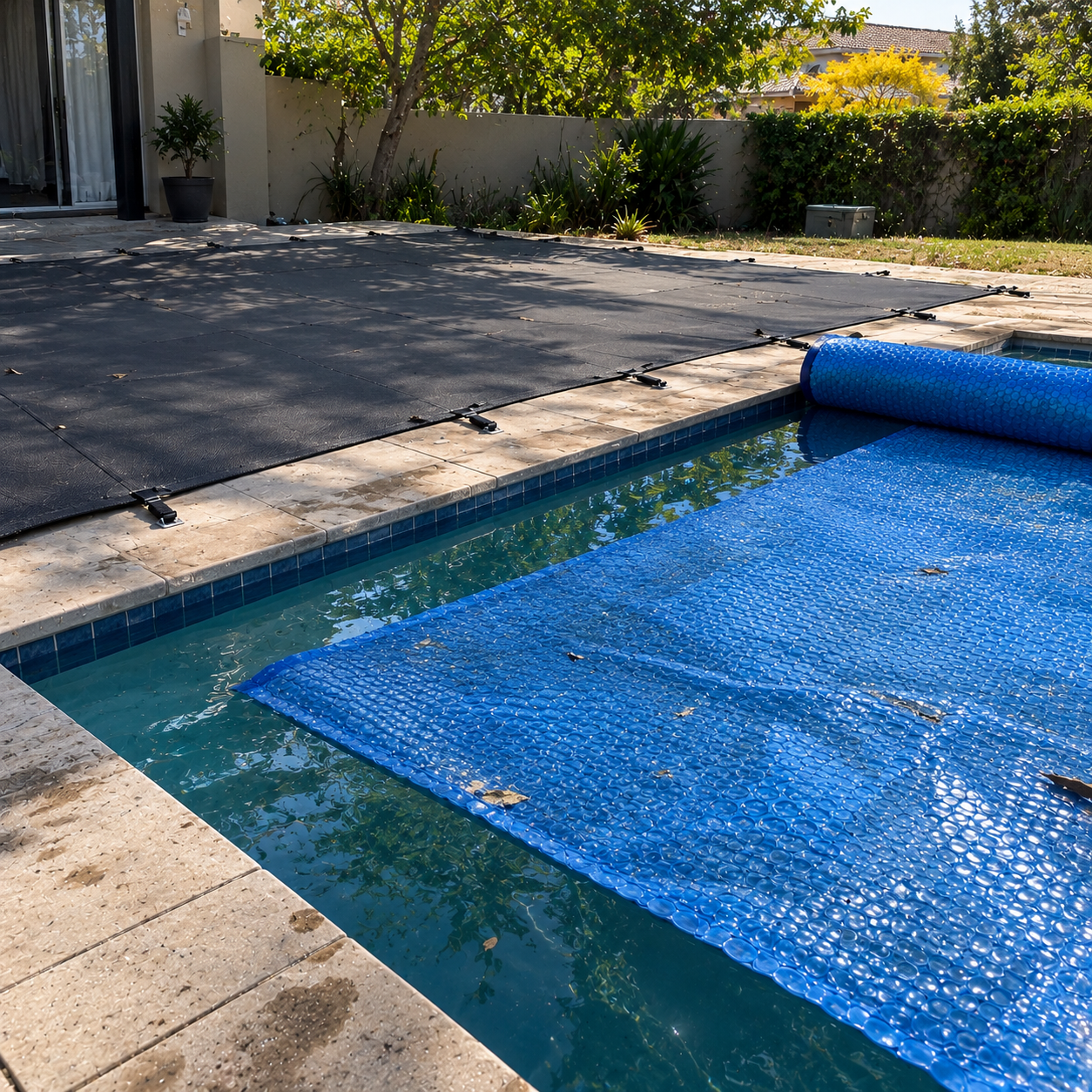
Choosing a swimming pool cover is about more than finding something that fits over the water. The right cover can help reduce water evaporation, retain warmth, limit debris and, in the case of a properly designed safety cover, help restrict access to the pool when it is not in use. The difficulty is that these benefits are not shared equally by every type of cover.
Two options that pool owners often consider are safety covers and bubble covers. At first glance, both appear to serve the same purpose because they cover the swimming pool. However, their construction, installation, everyday use and intended functions are quite different.
A bubble cover, also called a solar pool cover, floats directly on the water. It is mainly used to reduce evaporation and help retain heat. A safety cover is designed to span the pool and attach to suitable anchoring points around its perimeter. When a product is specifically designed for safety and correctly installed and maintained, it can help prevent accidental access to the water.
This distinction matters for households with children, pets or visitors, as well as for pool owners who want to manage water loss during Namibia’s hot, dry periods. A cover that helps conserve water is not necessarily a cover that protects against accidental entry. Similarly, a cover designed for safety should not automatically be expected to provide the same thermal performance as a bubble cover.
The most suitable option depends on what you want to achieve, how frequently the pool is used, the design of the pool and the conditions around your property. Understanding these differences before purchasing a cover can help you avoid choosing a product that does not meet your needs.
Find the Right Pool Cover for Your Swimming Pool
Need help choosing a pool cover? Fill in and submit the form below so Premium Pools Namibia can assist with your requirements.
Understanding Bubble Pool Covers
Bubble covers are among the most familiar types of swimming pool covers used for everyday pool maintenance. They are generally made from flexible plastic material containing numerous small air-filled bubbles. The material floats on the surface of the water, covering much of the pool when it is not being used.
Their main purpose is to reduce evaporation and help the pool retain heat. They are not designed to support a person or act as a barrier against accidental entry.
Although bubble covers are often called solar covers, their performance does not depend entirely on sunlight warming the water. One of their most important functions is reducing heat loss by limiting evaporation. This means they can help maintain water temperature even when their main contribution is preventing existing heat from escaping.
How does a bubble cover work?
Swimming pool water loses heat through several processes, including evaporation, convection and radiation. Evaporation is particularly important because energy is required for liquid water to change into water vapour. When water evaporates from the pool, some of the energy stored in the water is lost with it.
A bubble cover reduces the amount of water directly exposed to the surrounding air. The material creates a barrier across the surface, limiting evaporation and helping the water retain more of its heat.
Depending on its design, colour and material, a bubble cover can also allow some solar energy to pass through or absorb sunlight in ways that contribute to warming the water. The results depend on the cover itself, the amount of sunshine available, the pool’s exposure to wind and the difference between daytime and nighttime temperatures.
This is particularly relevant in Namibia, where strong sunshine and dry air can contribute to substantial evaporation. Wind exposure can increase water loss, making a suitable cover useful for pools in open gardens and exposed outdoor areas.
However, a bubble cover cannot eliminate every source of water loss. Splashing, backwashing, leaks and other maintenance activities can still reduce the water level. The cover should therefore be viewed as one part of effective pool management rather than a complete solution to every water-related problem.
Why pool owners choose bubble covers
The main attraction of a bubble cover is that it addresses several everyday pool-management concerns without requiring a permanent structure over the swimming area.
For a pool owner who wants to maintain a comfortable swimming temperature, the cover can help reduce heat loss when the pool is not in use. This may be particularly useful overnight, when temperatures fall and the pool is no longer receiving direct sunlight.
A bubble cover can also reduce evaporation. In a dry climate, preventing some of the water from escaping can help reduce the need for frequent topping up. The actual savings depend on the pool’s surface area, weather conditions, exposure to wind and consistency of use.
Another benefit is that the cover can reduce the amount of leaves and larger debris that fall directly into the water while the pool is covered. This may help reduce some cleaning demands, although dust and smaller particles can still enter around the edges or collect on top of the material.
Bubble covers are generally straightforward to handle. Smaller covers may be moved manually, while larger installations can benefit from a suitable roller system. A roller can make it easier to remove and replace the cover without dragging it unnecessarily across the pool surround.
The main limitation is that bubble covers are relatively delicate compared with products designed to span and secure across a pool. Prolonged exposure to sunlight when stored incorrectly, rough handling and unsuitable chemical conditions can shorten their useful life.
What are the limitations of bubble covers?
A bubble cover is useful only when its capabilities match the owner’s expectations.
It is not designed to support a person. If a child, adult or animal falls onto a bubble cover, the material may give way, and the person can become entangled in it or be submerged underneath it. It must never be treated as a safety barrier.
The cover also needs to be removed before swimming. Leaving it over the water while people are using the pool can create hazards and interfere with safe swimming.
Another consideration is storage. When removed, the material should be handled and stored according to the manufacturer’s instructions. Leaving it exposed to intense sunlight for extended periods can cause deterioration, depending on its construction and protective treatment.
Finally, a bubble cover does not remove the need for water testing, filtration, circulation or regular cleaning. It can reduce some maintenance demands, but the pool still needs appropriate chemical balance and routine care.
Understanding Pool Safety Covers
A safety cover is designed for a different purpose. Rather than floating loosely on the water, it spans the pool and is secured to suitable anchoring points around the perimeter. Depending on the product, it may be constructed from mesh or solid material, with straps, springs, anchors or other components forming part of the securing system.
The purpose is to create a barrier across the pool when it is not in use. A suitable safety cover is engineered and tested for specific performance requirements, and its ability to provide protection depends on the product’s design, correct installation and continued maintenance.
It is important to distinguish a genuine safety cover from a general-purpose winter cover or a sheet intended primarily to keep debris out. A cover may appear strong without having been designed or tested to prevent accidental entry.
How a safety cover provides protection
The cover spans the pool rather than simply floating on the water. Its securing system helps maintain the intended tension and position, while the material is designed to meet the requirements specified by the manufacturer.
Correct installation is essential. The pool’s shape, dimensions, surrounding paving and the condition of the anchoring points all influence whether the cover can be fitted properly.
A poorly fitted cover, damaged strap or loose anchor may compromise the system. For this reason, safety covers need to be installed and maintained according to the manufacturer’s instructions rather than improvised to fit an unsuitable pool surround.
Pool owners should also understand the product’s stated limits. Not every safety cover is designed to carry the same loads, and no cover should be assumed to be safe to walk on simply because it is taut.
A safety cover is an additional protective measure, not a substitute for supervision, secure access to the pool area or other appropriate safety precautions.
Mesh safety covers
Mesh safety covers contain openings that allow water to pass through the material. Their construction can reduce the accumulation of rainwater on the cover, depending on the mesh design and installation.
This can be useful in areas where rainfall may collect on a solid surface. However, the mesh also means that some fine debris, dust and sunlight may pass through. The amount depends on the size and construction of the openings.
A mesh cover may therefore reduce the amount of larger debris entering the pool without keeping the water completely isolated from the environment. The pool may still require cleaning, filtration and water treatment during periods when it is covered.
Solid safety covers
Solid safety covers use material intended to block water and debris from passing directly through the covered surface. Depending on the design, they may provide more complete protection against falling leaves and other debris than mesh covers.
However, water management becomes an important consideration. Rainwater can collect on a solid cover unless the system includes an appropriate drainage arrangement. The cover must be used according to its design requirements so that accumulated water does not create excessive loading or another hazard.
Solid safety covers can also limit the amount of sunlight reaching the water. This may help reduce conditions that encourage algae growth, although water chemistry and filtration still need to be maintained.
The choice between mesh and solid construction should be based on the pool’s surroundings, the expected weather conditions, the maintenance requirements and the specific product’s intended performance.
The Main Differences Between Safety Covers and Bubble Covers
Although both products cover a swimming pool, they are designed for different purposes. Understanding how they differ will help you choose a cover that meets your needs.
Bubble covers
-
Main purpose: Reduce water evaporation and help retain heat.
-
Position: Floats directly on the pool water.
-
Safety: Does not provide a safety barrier and cannot prevent accidental entry into the pool.
-
Heat retention: Designed to help the pool retain warmth, particularly when covered overnight.
-
Debris protection: Helps keep out some leaves and larger debris, although dust and other particles can still enter.
-
Installation and handling: Usually easy to lay over the water, remove and roll up for storage.
-
Maintenance: Requires appropriate cleaning, careful handling and protection from prolonged exposure to sunlight when stored.
Safety covers
-
Main purpose: Restrict access to the pool when the cover is correctly installed and secured.
-
Position: Spans the pool and attaches to suitable anchors around the perimeter.
-
Safety: Specifically designed for this purpose, subject to the product’s specifications, correct installation and maintenance.
-
Heat retention: Varies according to the material and design. Mesh covers generally behave differently from solid covers.
-
Debris protection: Depends on the construction, with solid and mesh designs offering different levels of protection.
-
Installation and handling: Requires suitable anchoring and correct fitting, with securing points released and fastened as instructed.
-
Maintenance: Requires inspection of the cover material, anchors, straps and other securing components.
The key difference is simple: choose a bubble cover primarily for heat retention and evaporation control. Choose a properly specified safety cover when restricting access to the pool is the priority.
Which Cover Is Better for Namibia’s Climate?
Namibia’s climate makes water conservation an important consideration for many pool owners. Hot weather, strong sunshine, dry air and wind can all influence how quickly a pool loses water and heat.
However, climate alone does not determine the right cover. A pool in an exposed garden may have different requirements from one protected by walls and landscaping. Likewise, a pool used daily has different practical needs from one that remains unused for long periods.
Reducing water evaporation
Where evaporation is the main concern, a bubble cover can be a practical option. By reducing the water surface exposed to the air, it helps limit evaporation whenever the pool is covered.
The potential benefit depends on how much of the pool is covered and how consistently the cover is used. A cover that is only placed over the pool occasionally will not provide the same ongoing evaporation control as one used whenever the pool is not needed.
Wind exposure also matters. A pool in an open area may experience different evaporation rates from one sheltered by buildings or boundary walls.
A cover can reduce water loss, but it should not be used to dismiss unexplained changes in the water level. If a pool continues losing substantial amounts of water despite being covered, the cause may involve splashing, backwashing, plumbing or a leak that needs further investigation.
Keeping the pool warmer
A bubble cover can help retain heat during cooler nights and periods when the pool is not receiving direct sunlight. This can be useful even in places that experience hot daytime temperatures.
Water temperatures do not respond only to daytime air temperatures. The pool can lose heat after sunset, especially when the water is warmer than the surrounding air and conditions favour evaporation.
Covering the pool when it is not in use helps limit that loss. The amount of heat retained depends on the material, weather, pool exposure and the temperature of the water before the cover is applied.
A safety cover may also affect heat loss, but the result varies with the product. A mesh cover, for example, is not equivalent to a floating bubble cover in its ability to reduce evaporation.
Protecting an unused pool
For pools that are not used frequently, safety may be the more important consideration. A safety cover can help restrict access when correctly fitted, provided it is a product specifically designed for that purpose.
This is especially relevant where children or pets could enter the pool area. Pool owners should consider the entire access arrangement, including gates, doors and other barriers, rather than relying on the cover alone.
If the pool is also expected to retain heat or reduce evaporation, the owner may need to consider whether a separate bubble cover is practical. Using multiple covers requires careful attention to compatibility, handling and the safety cover’s installation instructions.
The best arrangement is the one that addresses the actual needs of the property without compromising the function of either product.
Choose a Pool Cover That Suits Your Needs
Unsure which cover suits your pool? Fill in and submit the form below so Premium Pools Namibia can help you consider your options.
Can a Bubble Cover Be Used as a Safety Cover?
No. A standard bubble cover should never be relied upon to prevent a child, adult or pet from entering the water.
Bubble covers are designed to float on the pool surface. They are not engineered to span the pool under tension and provide the same protective function as a suitable safety cover. If someone falls onto a bubble cover, it may tear, collapse or wrap around them, increasing the danger.
This distinction is important because the word cover can create a misleading impression that all covers provide a similar level of protection. They do not.
A bubble cover may be useful for water conservation and temperature management, but it does not replace a safety barrier. A safety cover must be specifically designed for its intended purpose, installed correctly and maintained in good condition.
If you have young children in the household or children regularly visit your property, take a broader approach to pool safety. Secure access to the pool area, maintain appropriate barriers and ensure that children are actively supervised near water.
Even with a safety cover installed, follow the manufacturer’s instructions for securing it and checking its condition. Do not assume that every cover can support a person’s weight, and never allow someone to walk or play on it unless the product’s specific design and instructions explicitly permit the relevant use.
Will a Safety Cover Keep Pool Water Warm?
The answer depends on the type of safety cover and how it is constructed.
A solid safety cover may reduce some heat loss by limiting exposure to the air, but its thermal performance depends on the material and the way it fits over the pool. A mesh cover allows air and water to pass through its openings, which affects its ability to control evaporation and retain heat.
Bubble covers are specifically suited to reducing evaporation and helping maintain water temperature. They sit directly on the water, limiting the exposed surface area and reducing one of the major routes through which a pool loses heat.
For pool owners who want both safety and warmth, the choice requires a little more thought. A safety cover should be selected for its safety function, while any expected thermal benefits should be based on the manufacturer’s information rather than assumptions.
Other factors influence water temperature too. The pool’s location, exposure to sunlight, surrounding wind conditions, water volume and use of a heating system all affect how quickly the water warms or cools.
If the main objective is a more comfortable swimming temperature, a bubble cover may be the more suitable everyday option. If the main objective is restricting access, safety must take priority over the convenience of a floating cover.
How Do the Covers Affect Pool Cleaning and Water Quality?
A cover can reduce some maintenance demands, but it does not eliminate the need for proper pool care.
Debris entering the pool
Both types of cover can reduce the amount of debris falling directly into the water while the pool is covered. However, their effectiveness varies.
A bubble cover can keep out many leaves and larger objects, but dust and debris may still collect on the material or enter through gaps around the edges. When the cover is removed, material on its upper surface can also fall into the water if it is handled carelessly.
Mesh safety covers allow water to pass through and may permit some fine debris to enter. Solid safety covers provide a more complete physical barrier, although their performance depends on how well the cover fits and the characteristics of the material.
The number of trees near the pool, wind exposure and the design of the surrounding garden all influence how much debris enters the water.
Algae growth
Algae growth is influenced by several factors, including sunlight, available nutrients, water circulation and sanitiser levels.
A solid cover that limits sunlight reaching the water may help reduce one condition that supports algae growth. However, it does not eliminate the need to maintain appropriate water chemistry and filtration.
Bubble covers should be used according to the manufacturer’s instructions, particularly in relation to chlorine levels and chemical treatment. Some cover materials can be damaged by excessive chemical concentrations or by covering the pool before treatment chemicals have been properly distributed.
The appropriate procedure depends on the product and the chemicals being used. Following the manufacturer’s guidance helps protect the cover and supports effective pool maintenance.
Filtration and circulation
Neither cover replaces the pool’s filtration system. Pumps, filters and circulation outlets still need appropriate maintenance to keep the water clean.
A covered pool may collect less debris, but particles already in the water still need to be removed through filtration or cleaning. Water chemistry must also be monitored because covering the pool does not guarantee that sanitiser levels remain suitable.
If a pool becomes cloudy, develops algae or has unusual water chemistry while covered, investigate the underlying issue rather than assuming the cover itself will resolve it.
How Long Do Bubble Covers and Safety Covers Last?
The lifespan of a pool cover depends on its material quality, exposure to sunlight, frequency of use, storage conditions and maintenance. There is no single lifespan that applies to every product.
Bubble cover lifespan
Bubble covers are exposed to ultraviolet radiation, pool chemicals, heat and repeated handling. Over time, these factors can cause the material to become brittle, lose its flexibility or develop tears.
The cover may also deteriorate more quickly if it is left exposed to strong sunlight while stored off the pool, dragged across abrasive surfaces or handled roughly.
Using a suitable roller, storing the cover according to the manufacturer’s instructions and maintaining appropriate pool chemistry can help preserve the material. Regularly inspect the cover for damaged sections and replace it when it can no longer perform as intended.
Safety cover lifespan
Safety covers are also exposed to outdoor conditions, but their maintenance involves more than inspecting the fabric. The anchors, straps, springs, fasteners and surrounding fixing points all contribute to the performance of the system.
A cover that appears intact may still require attention if its securing components are loose, corroded or damaged. The condition of the surrounding paving or structure also matters because the cover depends on suitable anchoring points.
Inspect the system according to the manufacturer’s recommended schedule and address any signs of deterioration. If the cover has been damaged or its anchors have shifted, do not assume it remains safe to use until the problem has been properly assessed.
In both cases, regular maintenance can help identify problems early, but it cannot make a worn or damaged cover suitable indefinitely.
Can You Use a Bubble Cover and Safety Cover Together?
Some pool owners may consider using a bubble cover for heat retention and a safety cover for access restriction. While this may be possible in certain arrangements, the products must be compatible with the pool and with each other.
The two covers generally serve different functions and may be used at different times. A bubble cover can be placed on the water when the pool is not being used for swimming, while a safety cover can be installed when restricting access is required.
However, a bubble cover should not be placed beneath a safety cover unless the manufacturers confirm that the arrangement is appropriate. An extra layer could interfere with the safety cover’s fit, tension, drainage or intended performance.
The handling requirements also deserve consideration. Removing one cover and securing another takes time, and the process needs to be practical enough that the covers are used correctly and consistently.
Before choosing both, consider how frequently the pool is used, whether heat retention is a priority, the available storage space and the safety requirements of the property. The most important consideration is that adding a second cover must not compromise the safety function of the first.
What Should You Consider Before Buying a Pool Cover?
The best way to choose a cover is to start with the problem you want it to solve. Rather than focusing only on the appearance or purchase price, consider how the product will function in your particular pool environment.
Your primary objective: Decide whether you mainly want to reduce evaporation, retain heat, keep debris out or restrict access. A bubble cover is primarily suited to heat retention and water conservation, while a genuine safety cover is intended for access restriction.
Pool dimensions and shape: The cover must suit the pool’s size and layout. Curved edges, steps, built-in features and irregular shapes can affect fitting and handling. Safety covers also require appropriate anchoring points around the pool.
The surrounding surface: The condition and type of paving or other structure around the pool can influence whether a safety cover can be installed correctly. The anchoring system must be compatible with the installation surface.
How often the pool is used: A pool used every day may benefit from a cover that is convenient to remove and replace. A pool that is rarely used may have different requirements, especially if access restriction is a concern.
Local weather conditions: Strong sunlight, wind and dry conditions may increase the importance of evaporation control. Rainfall and the way water is managed on or around the cover are also relevant when choosing between different safety-cover designs.
Maintenance requirements: Find out how the material should be cleaned, stored and inspected. For safety covers, understand how to check the anchors, straps and other securing components.
Product specifications: Confirm the cover’s intended use and limitations. If safety is the priority, look for a product specifically designed and tested for that purpose, and follow the manufacturer’s installation requirements.
Ease of handling: Consider whether the people responsible for the pool can operate the cover correctly. A roller may simplify the use of a bubble cover, while a safety cover may require several fixing points to be secured every time it is installed.
These considerations help establish which cover is suitable before you commit to a particular design.
Common Mistakes to Avoid When Choosing a Pool Cover
One of the most serious mistakes is assuming that every pool cover offers safety protection. A bubble cover is not a safety barrier, and a general-purpose cover should not be treated as one simply because it fits tightly over the pool.
Another mistake is choosing a product based entirely on its ability to retain heat. Thermal performance is important, but it should not take priority over access restriction when the main concern is preventing accidental entry.
Pool owners may also underestimate the importance of correct installation. A safety cover relies on the condition of its material and the integrity of its anchoring system. If the pool surround is unsuitable or the fixing points are damaged, the cover may not perform as intended.
Ignoring maintenance can create similar problems. A bubble cover that has become brittle or torn may no longer provide effective surface coverage. A safety cover with damaged straps or loose anchors may no longer offer the expected protection.
Finally, some owners expect a cover to eliminate all pool maintenance. Although a cover can reduce debris and, depending on its design, limit evaporation or sunlight exposure, it does not replace water testing, filtration, circulation or regular cleaning.
Choosing the right product means understanding both its benefits and its limitations.
Choosing the Right Pool Cover for Your Property
Safety covers and bubble covers serve different purposes, and the right choice depends on your priorities.
If your main concerns are evaporation, heat retention and everyday pool maintenance, a bubble cover may be the more suitable option. Its floating design makes it practical for regular use, particularly when the pool is exposed to strong sunshine and dry conditions.
If your priority is restricting access when the pool is not in use, choose a safety cover specifically designed for that function. Its performance depends on the product’s specifications, correct installation, suitable anchoring and ongoing maintenance.
For some properties, the most appropriate approach may involve different covers for different purposes. However, compatibility and correct use are essential, and a bubble cover must never be treated as a substitute for a safety barrier.
Premium Pools Namibia can help you consider your pool’s requirements and the practical factors involved in selecting a suitable cover. The goal is to choose an option that matches how you use your pool, the conditions around your property and the function you need the cover to perform.
Get Advice on the Right Pool Cover
Ready to choose a pool cover? Fill in and submit the form below so Premium Pools Namibia can help you find a suitable option.


Comments are closed