


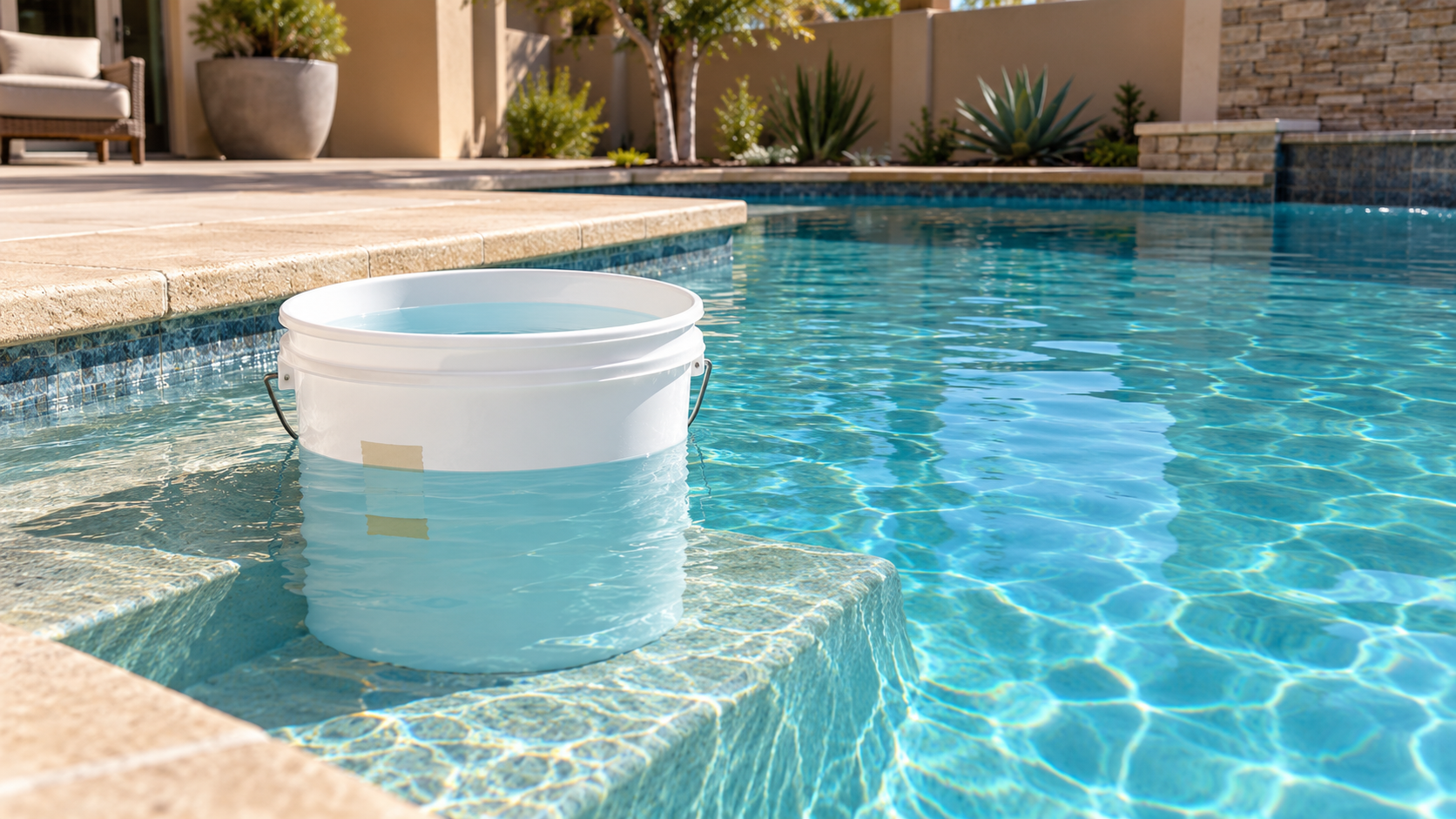
A falling pool water level does not automatically mean there is a leak. Evaporation, splashing and backwashing can all remove water. However, if you are topping up more often than usual, it is worth checking what is happening.
A 24-hour bucket test can help you compare your pool’s water loss with evaporation under similar conditions. It is a useful first check before arranging pool leak detection and repairs, although it cannot tell you where a leak is located.
Get Help With Pool Water Loss
Tell us where your pool is and what you’ve noticed. Premium Pools Namibia will get back to you to discuss leak detection and repairs.
Why Is Your Pool Losing Water?
Water leaves a swimming pool in several ways. Some escapes into the air through evaporation, while swimming and splashing carry water over the edge. Backwashing a filter or vacuuming to waste also lowers the level.
Leaks are another possibility. Water may escape through damaged pipework, fittings, equipment connections or parts of the pool structure. Some leaks are visible around the equipment; others remain concealed underground.
Start by considering what changed. A drop after backwashing has an obvious explanation. A persistent drop when nobody has used the pool deserves a closer look.
An automatic top-up system can make the pattern harder to notice because it replaces water as the level falls. A steady waterline therefore does not necessarily mean the pool is retaining its water.
How Much Evaporation Is Normal?
There is no single daily evaporation figure that reliably applies to every pool in Namibia.
Temperature, humidity and wind affect evaporation. The pool’s exposure, water temperature and use of a cover also influence how much water it loses. A sheltered pool and an exposed pool can behave differently, even within the same town.
That is why comparing your pool with a neighbour’s topping-up routine may not settle the question. Comparing its loss with a bucket exposed to similar conditions gives you a more useful starting point.
A suitable pool cover can reduce evaporation when used correctly. However, a cover does not repair a leak, so continuing unexplained water loss still needs attention.
Check These Things Before Testing
Think back over the last few days. Has the filter been backwashed? Has anyone vacuumed to waste, added water or used the pool heavily? Has rain raised the level?
Then look around the accessible equipment and surrounding area. Persistent drips, wet ground or water flowing from a waste outlet are worth reporting. They are clues, rather than proof of a particular fault.
If you notice leakage around your pool pump, filter or equipment connections, arrange an inspection. There is no need to complete a bucket test before reporting an obvious problem.
Get Help With Pool Water Loss
Tell us where your pool is and what you’ve noticed. Premium Pools Namibia will get back to you to discuss leak detection and repairs.
How to Do a 24-Hour Pool Bucket Test
You will need a clean, watertight bucket of approximately 20 litres, a ruler, waterproof tape or a suitable marker, and somewhere to record your measurements.
Choose a dry day without strong winds. Keep children and pets away from the pool and bucket throughout the test.
1. Prepare the Pool
Start with the pool at its normal operating level. Disable automatic topping-up and remove any filling hose.
For this initial test, keep the pump on its usual operating schedule and note the running times. A separate pump-off comparison may be useful later if a technician recommends it.
Switch off separately controlled fountains or waterfalls that cause splashing, and record that they were off. Do not alter unfamiliar valves or controls.
2. Position the Bucket Securely
Fill the bucket with pool water to approximately 25 mm below its rim.
Place it securely on a pool step or bench, partially submerged, with the rim above the pool water. It must not float, tip or allow pool water to wash over the top.
If there is no suitable place to position it safely, ask a pool professional for an alternative. A bucket left on hot paving may experience different temperatures from the pool.
3. Mark Both Starting Levels
Allow the water to settle. Mark the water level inside the bucket and the pool water level outside the bucket.
The two starting levels do not need to match. You will measure how far each falls from its own mark.
Record the starting time and take a photograph so you can identify the marks clearly.
4. Leave It for 24 Hours
During the test, do not swim, top up, backwash or vacuum to waste. Keep both water surfaces uncovered and prevent pets from drinking from or disturbing the bucket.
Maintain the pool’s barriers and access controls. If the pool cannot be left uncovered safely, arrange professional advice instead.
Restart the test if rain, added water, splashing or a moved bucket makes the comparison unreliable.
5. Measure Each Drop
After 24 hours, measure the distance in millimetres from each starting mark to its new water level.
Record the pool’s drop and the bucket’s drop separately. Compare those measurements—not simply whether the water in the bucket now sits higher than the pool water.
What Do Your Bucket Test Results Mean?
| Result | What it suggests | What to do next |
|---|---|---|
| The pool and bucket dropped by approximately the same amount | Evaporation may explain the loss during this test. | Continue monitoring if unusual topping-up persists. |
| The pool dropped noticeably more than the bucket | Water may be leaving the pool through another route. | Check for other water removal, then arrange investigation if unexplained. |
| The bucket dropped more than the pool, or the result is unclear | The conditions or setup may have affected the comparison. | Check the bucket, filling system and possible disturbances before repeating. |
For example, suppose the pool drops 8 mm while the bucket drops 3 mm. The pool has lost 5 mm more water level during that test.
That difference warrants investigation if no water was removed through backwashing, splashing or another known cause. It does not identify a damaged pipe, fitting or section of the pool.
Likewise, similar drops do not rule out every intermittent leak. A fault may occur only under particular operating conditions, including when equipment that was off during the test is running. Small differences can also be difficult to measure accurately.
When Should You Arrange Leak Detection?
Arrange an assessment if the pool repeatedly loses more water than the bucket, needs increasingly frequent topping-up, or continues losing water without a clear explanation.
Visible leakage, persistent wet patches or equipment losing prime are also reasons to seek help. These symptoms need investigation rather than a repair chosen on appearance alone.
Do not wait for the test to finish if the water is dropping rapidly or the pump can no longer draw water properly. Stop the test and obtain assistance; do not allow the pump to run dry.
Avoid draining the pool to look for the leak. Let the technician advise on the appropriate investigation and any changes to the water level.
Get Help With Pool Water Loss
Tell us where your pool is and what you’ve noticed. Premium Pools Namibia will get back to you to discuss leak detection and repairs.
What to Record Before Calling
Your observations can help the technician understand the pattern. Note:
- The pool and bucket measurements, with the test’s start and finish times.
- The pump schedule and which water features were operating.
- Any rain, topping-up, swimming or backwashing.
- Where you noticed drips, wet patches or other changes.
- How long the problem has been happening.
Photographs of the water-level marks and visible leakage can also help explain what you have observed. You do not need to identify the faulty component yourself before requesting assistance.
Get Help With Pool Water Loss in Namibia
Premium Pools Namibia provides pool leak detection and repairs across Namibia. If your pool keeps losing water or your bucket-test result needs further investigation, we can assess the problem and determine the appropriate repair.
Request a pool leak assessment and tell us your location, what you have noticed and any measurements you have taken.

Comments are closed