


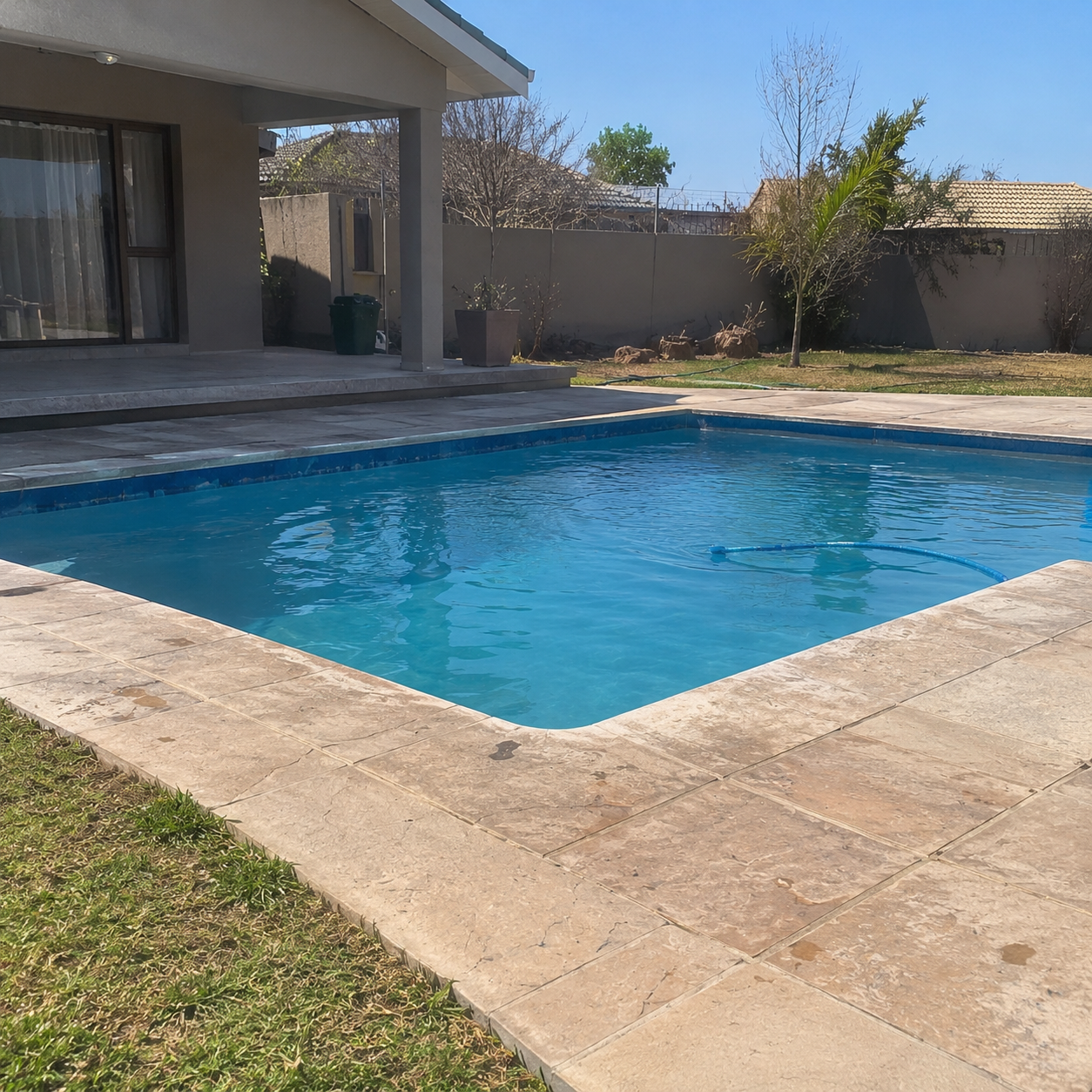
Pool decking is an important part of a swimming pool installation because it affects more than the appearance of the finished pool. The surface around the water needs to be comfortable to walk on, suitable for wet conditions, durable under Namibia’s climate and practical to maintain over time.
For homeowners planning a new swimming pool or upgrading an existing outdoor area, understanding pool decking pricing in Namibia is an important part of budgeting. The final cost depends on the material selected, the size of the area, the condition of the ground, the preparation required and the complexity of the installation.
A small, straightforward poolside area may require relatively little preparation, while a larger entertainment space with steps, curves, drainage channels and multiple finishes can involve considerably more work. Two projects with the same surface area can therefore have different installation costs.
Choosing the cheapest material is not always the best way to manage the budget. A surface that becomes uncomfortably hot, slippery when wet or expensive to maintain may not provide good long-term value. The aim should be to select decking that suits the property, the way the pool is used and the conditions in which it will be installed.
Get a Quote for Pool Decking in Namibia
Ready to upgrade your pool surrounds or complete a new pool area? Fill in the form below and submit your details so the Premium Pools Namibia team can discuss your pool decking project and requirements.
Estimated Pool Decking Prices in Namibia
Pool decking prices in Namibia depend on the material selected, the size of the area and the work required to prepare the ground. As a general budgeting guide, basic concrete decking may cost approximately N$350 to N$650 per square metre, while decorative concrete and paving can range from around N$450 to N$900 per square metre. Natural stone may cost N$700 to N$1,500 or more per square metre, while timber and composite decking can be more expensive depending on the product and supporting structure.
These figures are indicative estimates rather than verified current market prices. Actual costs may differ between suppliers and contractors, and it is important to establish whether a quoted rate includes materials, labour and installation.
The total cost also depends on site preparation, excavation, drainage, pool coping and the removal of existing surfaces. A straightforward installation on a properly prepared base may cost less than a project involving uneven ground, complicated edges or extensive drainage work.
When budgeting for pool decking, consider the full installation cost rather than choosing a material based solely on its price per square metre. Request a quotation based on your property’s measurements and requirements to establish a more realistic project budget.
What Determines Pool Decking Pricing in Namibia?
There is no single price that applies to every pool decking project. A reliable quotation needs to account for the actual site conditions, the chosen material and the work required to produce a stable, finished surface.
The Size of the Pool Decking Area
The total area is one of the first factors affecting the cost. Contractors generally need to establish how many square metres will be covered before estimating material quantities and installation labour.
However, the decking area is not necessarily the same as the pool’s water surface area. It includes the surrounding space required for walking, access, seating and other outdoor activities.
For example, a pool with a narrow walkway around its perimeter may need substantially less decking than a pool with a wide entertainment area, outdoor loungers and space for dining furniture. Homeowners should decide how they intend to use the space before finalising the layout.
Larger areas generally require more materials and labour, but the relationship between size and cost is not always straightforward. A compact area with complicated edges, extensive cutting or difficult access may require more detailed work per square metre than a larger, uncomplicated surface.
Accurate measurements are important when preparing a budget. Estimating only from the length and width of the swimming pool can result in too little material being allowed for the surrounding area. Curved pools, irregular boundaries and additional seating areas also need to be included in the calculations.
It is worth deciding early whether the project will cover the entire pool surround or only selected sections. This helps establish the actual scope of work and makes it easier to compare quotations from different contractors.
The Material You Choose
Material selection can make a significant difference to the overall budget. Concrete, paving, natural stone and timber or composite decking all have different purchase prices, installation requirements and maintenance needs.
Some materials require specialist installation or additional surface treatments. Others may be quicker to install but need a carefully prepared base to prevent movement or unevenness.
When comparing materials, consider the complete installed cost rather than looking only at the price of the product. The quotation should account for the preparation, installation, finishing and any additional components needed to make the surface suitable for use around a swimming pool.
The intended appearance also matters. A simple concrete finish may suit a contemporary property, while natural stone or patterned paving may complement a landscaped garden. Timber-style decking can create a more defined entertainment space, although it may require a different supporting structure.
Before choosing a product, consider how it will look alongside the pool coping, exterior walls, garden and outdoor furniture. Selecting complementary finishes at the planning stage can help avoid expensive alterations later.
Ground Preparation and Existing Conditions
The condition of the ground can substantially affect the cost of a pool decking project. Before a surface is installed, the area may need excavation, levelling, compacting or the removal of an existing finish.
Uneven ground, loose soil and areas with poor drainage can require additional preparation. If the pool surrounds have settled or the existing surface is cracked, the cause may need to be investigated before new decking is installed.
Installing a new finish over an unstable base can lead to cracking, movement or uneven sections later. Although proper preparation adds to the initial project cost, it helps establish a more reliable foundation for the finished surface.
Renovation projects can also involve removing old paving, concrete or damaged decking. These activities may add labour, disposal and transport costs that would not necessarily apply to a new installation.
The amount of excavation required depends on the chosen material and the existing ground levels. Concrete installations, for example, require suitable preparation before the concrete is placed, while paving generally needs an appropriately prepared and compacted base. Raised timber or composite decking may require supports and a substructure designed for the intended loads.
These differences make a site assessment particularly useful when planning an upgrade. The existing surface may appear suitable at first, but hidden settlement, poor drainage or deterioration beneath the finish can affect the scope of work.
Drainage and Water Management
Water management is an important consideration when planning pool surrounds. Water from splashing, cleaning and rainfall needs to drain appropriately without creating persistent puddles or directing excessive moisture towards buildings.
The finished surface must be designed with suitable falls and drainage provisions for the site. Depending on the layout, the work may require drainage channels, additional excavation or adjustments to the surrounding ground.
These requirements influence the design and installation cost, particularly where the pool is close to a house, retaining wall or other structure.
Drainage should be planned before the final surface is installed. Retrofitting drainage after completion can involve lifting paving, cutting concrete or disturbing sections of the finished deck.
Poor drainage can also affect the long-term condition of the decking. Water that remains trapped around joints or beneath certain installations may contribute to deterioration, movement or maintenance problems. The appropriate solution depends on the material, site levels and the way water moves through the area.
A good design should consider the direction of runoff, nearby doors and buildings, and the relationship between the deck and pool coping. These details are easier to address during planning than after the finished surface is in use.
Comparing Pool Decking Materials
The most suitable decking material depends on the property’s style, the available budget, the expected use of the pool area and the amount of maintenance the owner is prepared to undertake.
Concrete Pool Decking
Concrete is a practical option for homeowners who want a durable, relatively simple surface around their swimming pool. It can be finished in different ways, including brushed, textured or decorative finishes, depending on the desired appearance and installation method.
Its overall cost depends on the thickness and specification of the concrete, reinforcement requirements where applicable, ground preparation, access and the chosen finish. Decorative treatments may add to the price compared with a basic finish.
In Namibia, heat exposure and direct sunlight should be considered when selecting the colour and finish. Some concrete surfaces can become uncomfortable underfoot during hot weather, while poorly designed or executed concrete may crack as a result of ground movement, shrinkage or other stresses.
A properly prepared base, suitable joints and appropriate drainage all contribute to the performance of the finished deck. Concrete should also have a texture that provides suitable grip when wet without being excessively rough for bare feet.
Another consideration is repairability. If a section of concrete becomes damaged, matching the original colour and finish can be difficult, particularly where decorative coatings have been applied. Homeowners should understand how the chosen finish is maintained and repaired before committing to it.
Concrete may suit homeowners looking for a relatively uniform appearance and a continuous walking surface. The design should still account for the pool’s shape, the required drainage and the expansion or control joints appropriate for the installation.
Paving and Interlocking Pavers
Paving is another option for pool surrounds. Individual pavers are available in different shapes, colours, sizes and finishes, making it possible to create a simple layout or a more decorative design.
One advantage of paving is that individual units can sometimes be lifted and reinstated if access to underlying services is required. Localised repairs may also be easier than repairing a large continuous concrete surface, provided the original paving and installation materials are still available.
The installed cost depends on the type and quality of the pavers, the preparation of the base, edge restraints, cutting requirements and labour. Patterns involving multiple sizes or intricate borders may require more installation time.
Pavers need a stable, properly compacted base to limit movement and unevenness. Joints and surface levels also require attention because loose or raised units can create trip hazards around the pool.
For swimming pool use, the selected paving should provide appropriate slip resistance and be comfortable enough for barefoot movement. Not every paving product is suitable for a wet poolside environment, so its intended application should be confirmed before purchase.
The colour and texture of paving can influence both its appearance and its practical performance. Lighter colours may be worth considering in exposed areas, while highly textured products may require more effort to keep clean. The suitability of each product should be assessed individually rather than assuming all paving performs in the same way.
Natural Stone Pool Decking
Natural stone can give a pool area a distinctive appearance, with variations in colour, texture and pattern. Depending on the stone selected, it can complement contemporary architecture, traditional homes or outdoor entertainment spaces.
Pricing varies considerably because different stone types have different material costs, thicknesses, finishes and installation requirements. Stone that needs specialist cutting or careful matching may also require more labour.
The appearance of natural stone should not be the only consideration. Porosity, surface texture, heat absorption, resistance to weathering and compatibility with pool chemicals all matter when selecting a product for this application.
Some stones may need sealing or periodic maintenance, depending on their properties and the manufacturer’s recommendations. Sealing should not be assumed to make an unsuitable stone appropriate for poolside use, nor should it compromise the surface’s slip resistance.
Before committing to a particular product, ask for a sample and check its finish, maintenance requirements and suitability for repeated exposure to water and sunlight.
Natural stone may also vary from piece to piece. This variation is part of its appeal, but it means homeowners should understand how the finished surface may differ from a small showroom sample. Where consistency is important, inspect representative samples before ordering the full quantity.
Installation quality is equally important. The stone must be supported correctly, and joints, edges and drainage need to be addressed as part of the complete design.
Timber and Composite Decking
Timber-style decking can create a warmer, more defined outdoor entertainment area. Natural timber offers a particular appearance, while composite products are manufactured to provide a timber-like finish with different maintenance characteristics.
The cost depends on the product, the supporting structure, fastening system, edge detailing and the amount of cutting required. Raised decks or designs that require steps and changes in level may involve more work than decking installed over a suitable existing structure.
Natural timber may need periodic cleaning, sealing or other treatment, depending on the species and exposure conditions. Composite decking can reduce some maintenance tasks, but it is not maintenance-free and still requires appropriate cleaning and installation.
Heat is especially important when selecting decking in a sunny Namibian garden. Some composite products and darker finishes can become very hot in direct sunlight. The surface should also be suitable for wet conditions, with attention to drainage, ventilation and the manufacturer’s installation requirements.
Timber or composite decking should not be selected on appearance alone. Confirm that the product is designed for the intended poolside application and that the supporting structure can safely accommodate the installation.
The substructure is an important part of the overall budget. Depending on the design, it may require framing, supports, fixings and suitable clearance beneath the boards. These elements should be included in the quotation rather than treating the boards as the only material cost.
Homeowners should also consider how the deck will connect to the pool coping and surrounding ground. Poorly planned transitions can create awkward level changes, drainage issues or areas where dirt accumulates.
Get a Quote for Pool Decking in Namibia
Ready to upgrade your pool surrounds or complete a new pool area? Fill in the form below and submit your details so the Premium Pools Namibia team can discuss your pool decking project and requirements.
How Namibia’s Climate Affects Your Decking Choice
Pool decking in Namibia needs to cope with conditions that can include intense sunlight, high summer temperatures, dust and seasonal rainfall. The effect of these conditions varies by region, elevation and the amount of shade around the property.
Heat and Direct Sunlight
A pool deck may receive direct sunlight for much of the day, especially in an exposed garden. The temperature of the surface can influence how comfortable it is to walk around the pool barefoot.
Colour, material composition, surface texture and exposure all affect how hot decking becomes. A product that looks attractive in a showroom may feel very different after hours of direct sunlight.
Where possible, assess material samples outdoors and ask suppliers about their performance in hot conditions. Shade from trees, pergolas or suitable outdoor structures can also improve comfort, although these features introduce their own design, installation and maintenance considerations.
Shade planning should form part of the wider pool layout. If seating and lounging areas will be used throughout the day, positioning them where shade can be provided may improve comfort without requiring a complete redesign later.
The amount of sunlight a surface receives also affects how it weathers over time. Some finishes may fade, become discoloured or require periodic treatment depending on the product and exposure. Confirm the manufacturer’s guidance on suitability for outdoor use before selecting a finish.
Dust, Wind and Cleaning
Dust and windblown debris can accumulate around pools, particularly in exposed areas. Textured surfaces, joints and gaps may collect dirt differently, affecting how often the deck needs to be swept or washed.
A surface should be practical to clean without requiring aggressive methods that damage the finish. Consider how cleaning water will drain and whether the chosen material tolerates the products used to maintain the pool area.
The surrounding garden also affects cleaning requirements. Trees and shrubs can provide shade, but leaves, pollen and other organic debris may accumulate on the deck and enter the pool. The placement of planting, outdoor furniture and access paths can influence how easy it is to keep the area tidy.
Where a low-maintenance finish is a priority, ask how the product should be cleaned and whether it requires special detergents or protective treatments. A material that is straightforward to maintain may be more convenient for a household that uses the pool frequently.
Water Exposure and Seasonal Rain
Although pool decking is designed to be used around water, repeated wetting can affect materials, joints and supporting structures. Pool chemicals, cleaning agents and standing water may also influence the condition of some finishes over time.
The layout should allow water to drain efficiently, while the selected material should be appropriate for wet conditions. In areas that receive seasonal rainfall, the drainage design needs to accommodate runoff rather than relying only on the small amount of water generated during normal pool use.
Slip resistance deserves particular attention. A surface that performs well in dry conditions may behave differently when wet, especially if algae, dust or other deposits accumulate. Selecting a suitable finish and maintaining it properly helps support safer movement around the pool.
It is also important to keep the decking and coping in good condition. Raised paving, damaged boards, loose edges and deteriorating joints should be addressed before they become larger problems.
Additional Costs to Include in Your Pool Decking Budget
The surface material is only one part of the total project cost. Several supporting elements can influence the final quotation, and overlooking them can leave homeowners with an incomplete budget.
Pool Coping and Edge Finishing
Pool coping is the material used to finish the edge of the swimming pool. It provides a transition between the pool shell and the surrounding deck while contributing to the overall appearance of the installation.
Coping may be included in a new pool construction quotation, but it should be checked separately when upgrading an existing pool. Replacing damaged coping, matching an existing finish or installing curved sections can add to the project cost.
The selected coping must be appropriate for the pool’s construction and compatible with the surrounding decking. Its finish, installation and joints should also be suitable for a wet environment.
Coping is especially important where different materials meet. The transition should be planned to minimise abrupt level changes and avoid areas that could collect water or create a trip hazard.
Steps, Borders and Changes in Level
A straightforward rectangular deck is generally simpler to set out than one with multiple corners, curves, steps and decorative borders.
Each additional detail can involve extra cutting, measurements, materials and installation time. Raised areas may also require additional structural work, while steps need to be designed with safe and consistent dimensions.
These details are worth planning early. Changing the layout after materials have been ordered or installation has started can lead to additional labour and material wastage.
Decorative borders and contrasting finishes can add visual interest, but they also need to be coordinated with the overall layout. If the design uses several materials, each transition must be considered during installation to ensure the completed surface is practical and cohesive.
Drainage Channels and Surface Falls
Some pool surrounds require drainage channels or other measures to direct water away from the pool and nearby buildings. The need for these features depends on the site’s slope, the surrounding structures and the expected water flow.
Surface falls must be planned carefully so that water drains without creating uncomfortable or uneven walking areas. Drainage covers should also be suitable for the location and installed without introducing unnecessary trip hazards.
A quotation should clarify whether the drainage work includes excavation, channel installation, connections and reinstatement of the surrounding surface. The amount of work required can vary significantly from one property to another.
Access, Delivery and Waste Removal
Transport and site access can influence the cost of materials and labour. A property with restricted access may require materials to be carried further or delivered in smaller quantities.
Renovation projects may also involve removing old surfaces and disposing of rubble. If the existing deck needs to be broken up, the quotation should make clear whether demolition, loading, transport and disposal are included.
These practical details are especially important when comparing quotations from different contractors. One quotation may cover the complete installation, while another may exclude preparation or waste removal.
Sealing, Finishing and Ongoing Maintenance
Some decking materials require protective treatments or specific finishing products. Depending on the selected material, these may need to be applied during installation and renewed periodically.
The initial quotation should specify whether sealing or other finishing work is included. If a material requires regular treatment, homeowners should also consider the cost of maintaining it over the years.
Not every material requires the same level of attention. The most appropriate choice depends on the homeowner’s priorities, the product’s properties and the conditions around the pool.
How to Compare Pool Decking Quotations
A useful quotation should explain the work required, the materials being supplied and the preparation needed before installation. Rather than comparing only the final totals, check whether each contractor is quoting for the same scope of work.
The quotation should ideally identify the following:
-
Measured area: The number of square metres to be covered, including any separately priced steps, borders or additional sections.
-
Material specification: The product, finish, dimensions and other relevant details of the proposed decking.
-
Preparation work: Any excavation, levelling, compaction, removal of existing surfaces or other base preparation.
-
Installation and finishing: Labour, cutting, joints, edge restraints, coping and any specified surface treatment.
-
Drainage provisions: The planned falls, channels or other measures required to manage water.
-
Additional charges: Delivery, waste removal, access requirements and any work excluded from the quoted amount.
Ask how unexpected problems will be handled if they are discovered during installation. For example, removing old decking may reveal an unstable base or drainage problem that was not visible during the initial assessment. Understanding how additional work will be priced can help prevent disagreements later.
It is also worth asking about the expected maintenance requirements of the proposed material and the warranty or workmanship terms offered. These details help establish what is covered after installation and what ongoing care will be the homeowner’s responsibility.
When reviewing quotations, check whether the material quantities include a reasonable allowance for cutting and wastage. This is particularly relevant for irregular pool shapes, diagonal patterns or layouts with multiple borders. The appropriate allowance depends on the material and design, so it should be explained rather than assumed.
Payment terms should also be clear. Homeowners should understand when deposits and progress payments are due, what milestones they relate to and how changes to the agreed scope will be handled.
A detailed quotation does not automatically guarantee quality, but it makes the proposed work easier to understand. It also gives both parties a clearer reference point if questions arise during the installation.
Pool Decking Repair or Replacement?
Not every existing pool deck needs to be removed completely. In some cases, a localised repair or partial upgrade may be sufficient, depending on the condition of the surface and the underlying structure.
Loose paving, for example, may be repairable if the problem is limited to a small section and the underlying base can be corrected. Individual damaged boards may also be replaceable in some decking systems, provided the supporting structure remains sound.
More extensive work may be necessary when cracking, settlement or water accumulation affects a large area. Repeated surface failures can indicate that the original preparation, drainage or installation needs to be addressed rather than simply covering the visible damage.
Before installing a new finish over an existing deck, establish whether the old surface is stable and suitable to remain in place. Adding another layer without checking levels, drainage and structural condition can create problems with door thresholds, pool coping and water flow.
The best decision depends on the extent of the damage, the condition of the base and the cost of achieving a durable result. A site assessment can help determine whether repairs, partial replacement or a complete upgrade is the more practical option.
Homeowners should also consider how long they intend to remain in the property and how the pool area will be used. A limited repair may be appropriate when the existing deck is largely sound, while a broader upgrade may make more sense when the layout no longer meets the household’s needs.
How to Plan a Pool Decking Project That Offers Long-Term Value
A well-planned pool deck should suit the way the household uses the pool, the conditions around the property and the available budget. Appearance matters, but the surface also needs to perform well under regular foot traffic, wet conditions and exposure to the elements.
Start by deciding how much usable space is needed around the pool. A narrow access path has different requirements from an entertainment area intended for loungers, outdoor dining and frequent gatherings. Planning the layout first helps avoid paying for unnecessary surface area or discovering later that the deck is too small for its intended use.
Next, compare materials based on more than their initial purchase price. Consider installation requirements, expected maintenance, heat underfoot, slip resistance and the availability of replacement materials if repairs become necessary.
It is also sensible to finalise drainage and coping details before installation begins. These elements are closely connected to the finished deck and can be more difficult or expensive to correct once the surface is in place.
Finally, allow room in the budget for site-specific requirements that may only become clear after inspection. A realistic quotation should distinguish the confirmed work from potential additional costs rather than relying on an attractive starting price that excludes essential items.
A useful way to organise the planning process is to separate the project into three priorities. First, establish the essential requirements, such as safe access, drainage and a suitable surface. Second, decide which aesthetic features are important, including colours, borders and complementary finishes. Third, identify optional additions, such as extra entertainment space, decorative features or additional shade.
This approach makes it easier to make decisions if the initial estimate exceeds the available budget. Essential installation requirements should not be compromised simply to accommodate decorative upgrades. Optional features can be adjusted while keeping the core project practical and suitable for the property.
Get a Quote for Pool Decking in Namibia
Ready to upgrade your pool surrounds or complete a new pool area? Fill in the form below and submit your details so the Premium Pools Namibia team can discuss your pool decking project and requirements.

Comments are closed